

BLOODSTONE TUMBLE
BLOODSTONE TUMBLE
Bloodstone
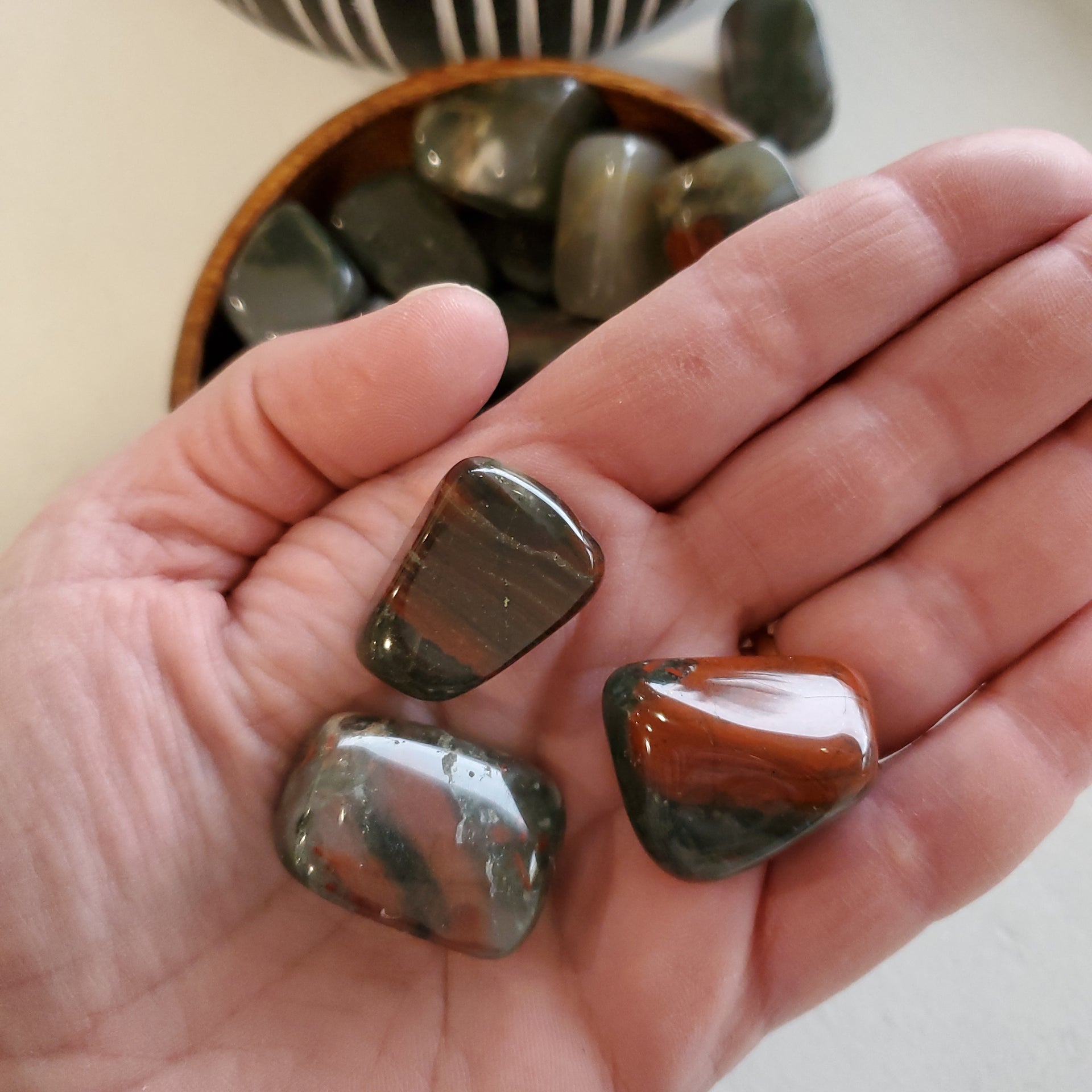
This striking Bloodstone Tumble is one of the most historically significant and visually distinctive stones in the crystal world — its deep forest green Chalcedony dramatically spotted with vivid red flecks of iron oxide has captivated healers, warriors, and mystics for over 5,000 years, earning it a place in the gemstone collections of ancient Egypt, Rome, and medieval Europe alike.
Note: Bloodstone is also known as Heliotrope — its classical and mineralogical name, from the Greek helios (sun) and trepein (to turn). Ancient writers believed that Bloodstone placed in water would turn the reflection of the sun blood red. Bloodstone is the traditional birthstone for March and the zodiac stone for Aries.
Where It Is Found
Bloodstone is found in several locations worldwide, with major sources in India (the Kathiawar Peninsula of Gujarat, the world's primary commercial source of Bloodstone for the crystal market), Brazil, Australia (Western Australia), China, Madagascar, and the United States. India has been producing Bloodstone for thousands of years and remains the dominant source of the polished Bloodstone available in the crystal market today.
Mineral Class / Geology
Bloodstone is a variety of Chalcedony (microcrystalline silicon dioxide, SiO₂) in the Tectosilicate mineral class, with a hardness of 6.5–7 on the Mohs scale. It belongs to the broader Quartz family and is specifically classified as a plasma (opaque green Chalcedony) with red spots. The deep green color is caused by inclusions of chlorite or hornblende (green silicate minerals) within the Chalcedony matrix, while the distinctive red spots are caused by inclusions of iron oxide (hematite or jasper). Bloodstone forms in volcanic rocks — particularly in the cavities and vesicles of basaltic lava flows — as well as in sedimentary and metamorphic environments. It has been used as a gemstone and healing stone since at least 3000 BCE. In medieval Europe, Bloodstone was believed to have been formed at the crucifixion of Christ — legend held that drops of Christ's blood fell on green jasper at the foot of the cross, creating the first Bloodstone — making it one of the most sacred stones in Christian tradition and widely used in religious carvings and seals.
Colors
Bloodstone displays a deep forest green to dark green base — caused by chlorite or hornblende inclusions — dramatically spotted and streaked with vivid red, orange-red, and occasionally yellow spots of iron oxide. The contrast between the deep green and vivid red spots is immediately striking and completely unique to each piece.
Metaphysical Properties
Bloodstone is known as the Stone of Courage, Vitality, and Purification. It has been used as a powerful healing and protective stone across virtually every ancient civilization. It resonates with the Root and Heart Chakras and is used to boost physical vitality, strength, and endurance, enhance courage, determination, and the will to overcome obstacles, purify and detoxify the blood and physical body, provide powerful protection against negative energies and threats, support the immune system and physical healing, enhance decision-making and the ability to act with integrity under pressure, and connect with the deep, primal life force energy of the Earth.