
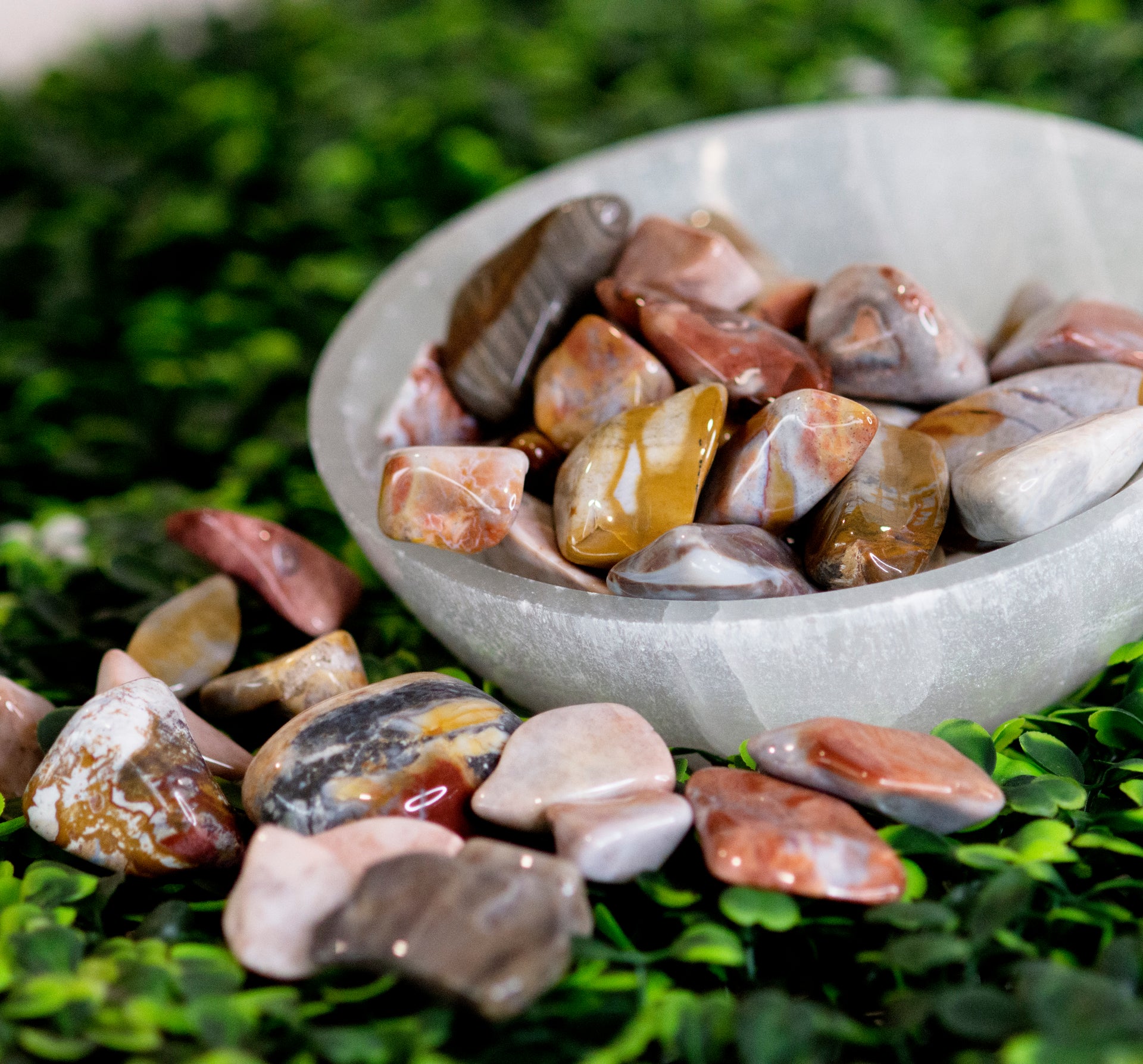
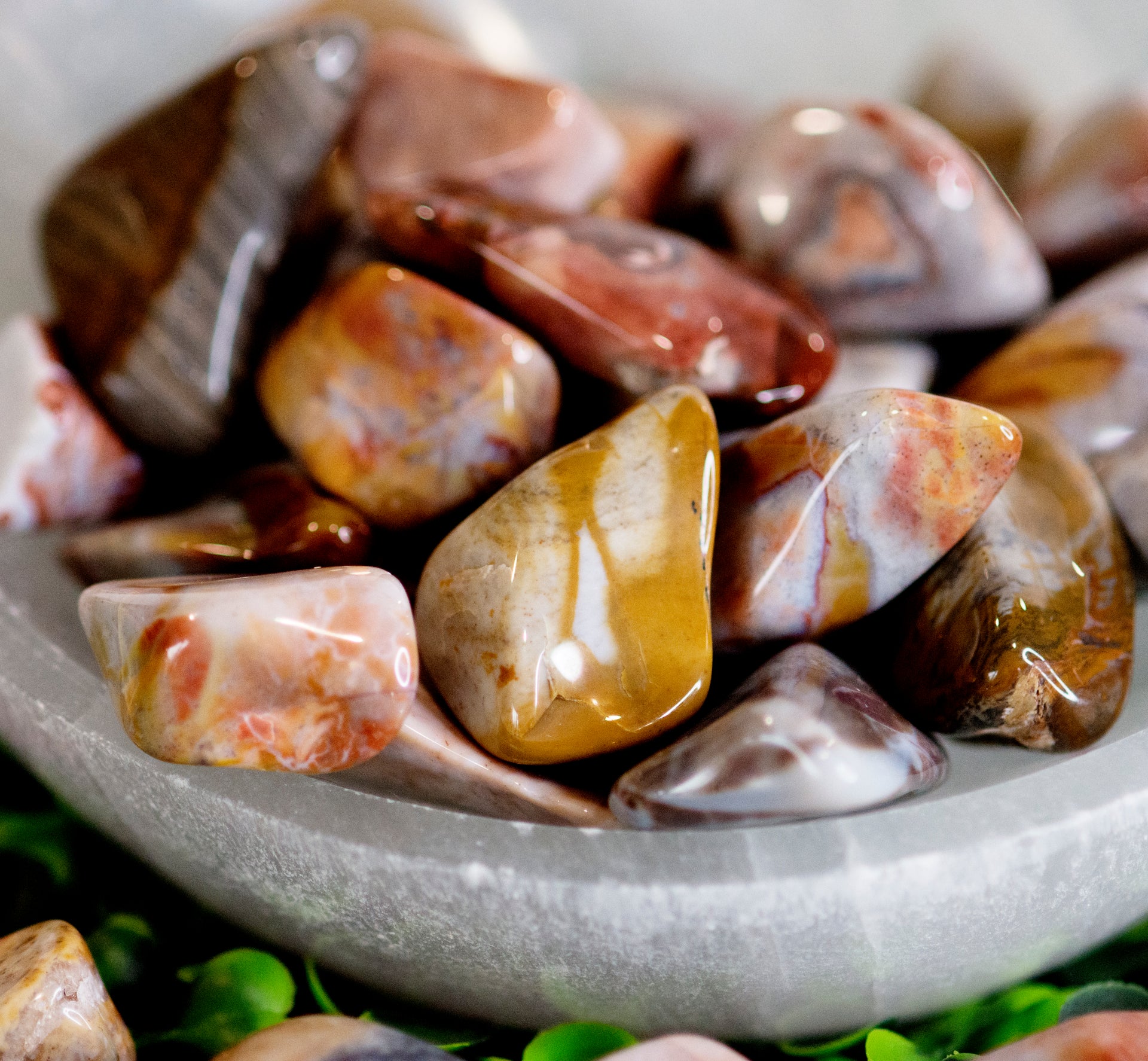
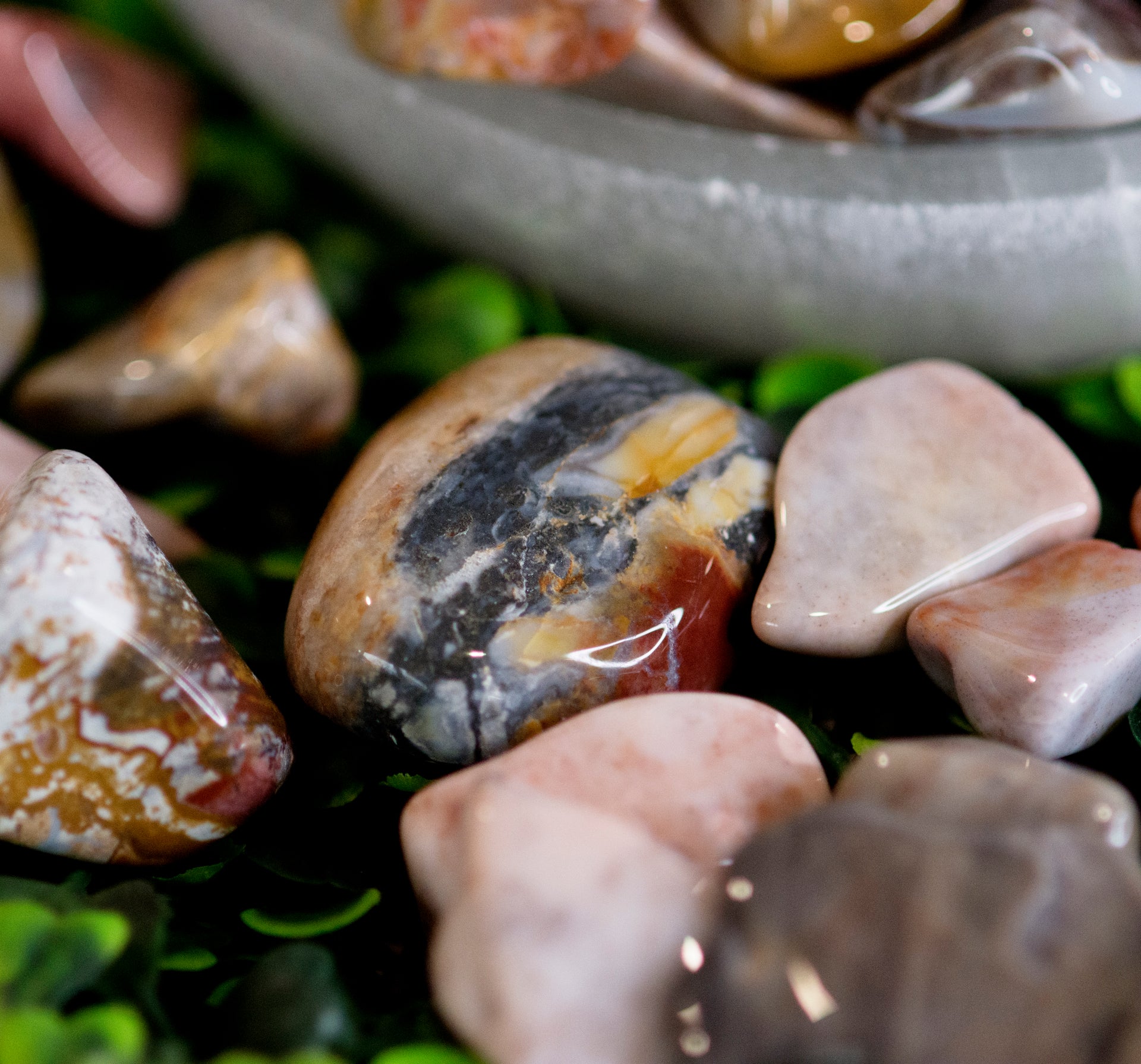
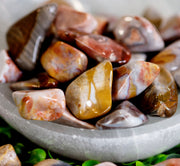
FLINT TUMBLE
FLINT TUMBLE
Flint
This fascinating Flint Tumble is a stone with one of the most profound and intimate relationships with human history of any mineral on Earth — for over 3 million years, our ancestors shaped Flint into tools, weapons, and fire-starting implements that were the very foundation of human technological development, making it one of the most historically significant stones you can hold in your hand.
Where It Is Found
Flint is found worldwide wherever chalk or limestone formations occur, as it forms within these sedimentary rocks. Major sources include England (the chalk downs of Norfolk, Suffolk, and the South Downs — historically one of the most important sources of Flint for tools and building material in Europe), France (the famous Flint mines of Spiennes in Belgium and Grand-Pressigny in France), Denmark, Poland, and throughout the Middle East (the Levant region, where some of the earliest known Flint tool industries developed). Flint nodules are commonly found in chalk cliffs and riverbeds across Europe and the Middle East.
Mineral Class / Geology
Flint is a variety of microcrystalline Quartz (Chert) composed primarily of silicon dioxide (SiO₂) in the Tectosilicate mineral class, with a hardness of 7 on the Mohs scale. It is essentially a fine-grained form of Chert that forms specifically within chalk and limestone sedimentary formations. Flint forms when silica — derived from the dissolved silica skeletons of marine organisms such as sponges, radiolaria, and diatoms — precipitates and replaces the surrounding carbonate rock during diagenesis (the process by which sediment is converted to rock). This is why Flint nodules are often found in chalk — the chalk itself formed from the accumulated shells of microscopic marine organisms, and the Flint formed within it from their silica skeletons. Flint's most important physical property is its conchoidal fracture — it breaks in smooth, curved, shell-like surfaces with extremely sharp edges, making it ideal for knapping (shaping by striking) into tools and weapons. This property made Flint the most important raw material in human prehistory for over 3 million years, from the earliest Oldowan stone tools through the Paleolithic, Mesolithic, and Neolithic periods. Flint was also used to produce fire by striking it against iron pyrite or steel — a use that continued well into the 18th century in flintlock firearms.
Colors
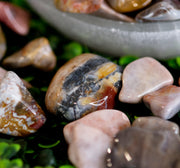
Flint displays a range of dark grey, black, brown, and occasionally white or cream colors — often with a waxy to dull luster on natural surfaces and a glassy, conchoidal fracture surface when broken. Tumbled Flint has a smooth, waxy surface that reveals its subtle color variations and occasional banding.
Metaphysical Properties
Flint is known as the Stone of Ancient Fire, Survival, and Primal Strength. Its 3-million-year relationship with humanity gives it a uniquely deep, ancestral energy — it carries the memory of every hand that shaped it, every fire it sparked, and every tool it became. It resonates with the Root Chakra and is used to connect with ancestral wisdom and the deep memory of the Earth, ignite inner fire, courage, and primal survival instinct, provide powerful grounding and protection, support resilience, resourcefulness, and the ability to find solutions under pressure, cut through confusion and illusion with clarity and precision, connect with the ancient, elemental energies of fire and Earth, and awaken a deep sense of one's own strength and capacity to endure.