
PYRITE TUMBLE
PYRITE TUMBLE
Pyrite
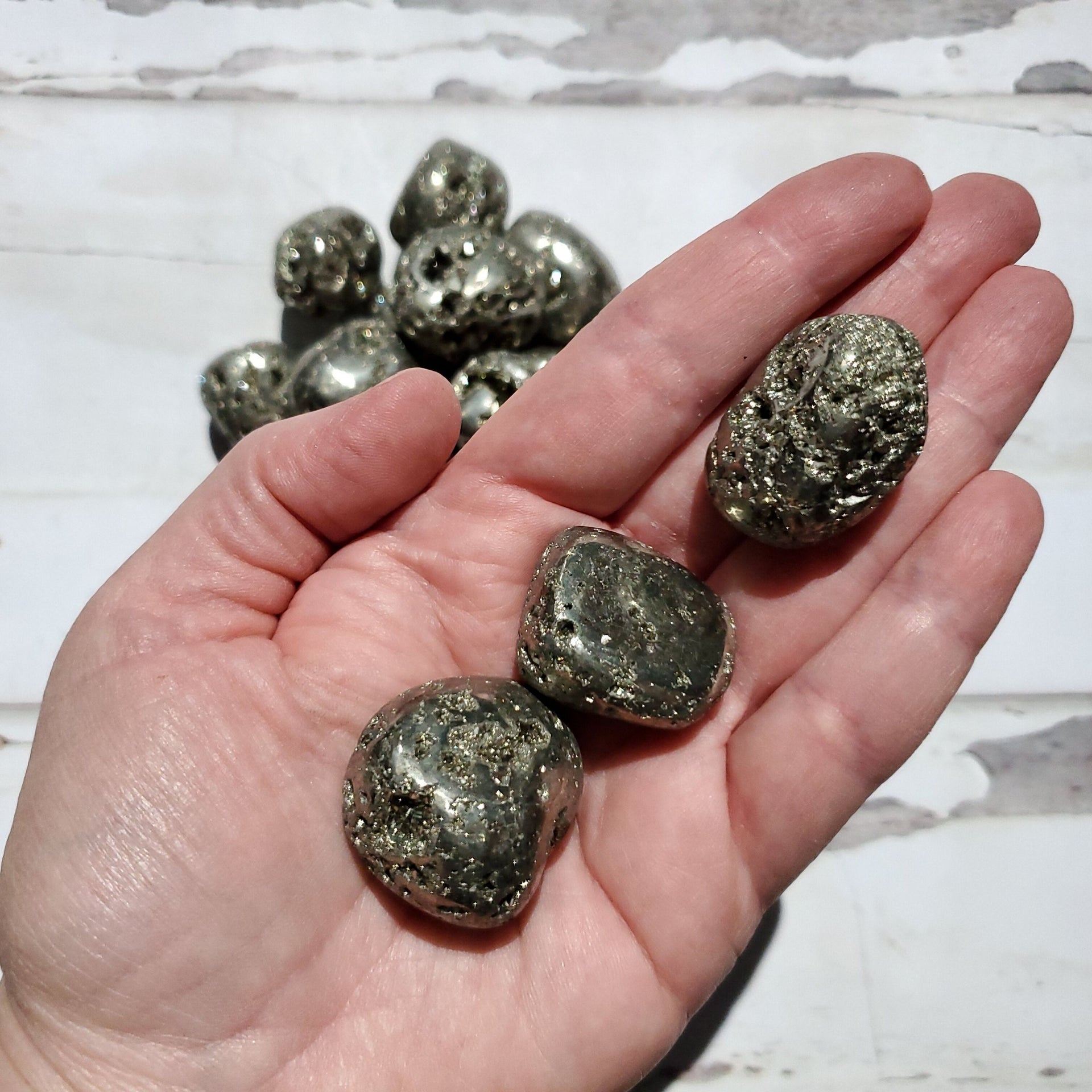
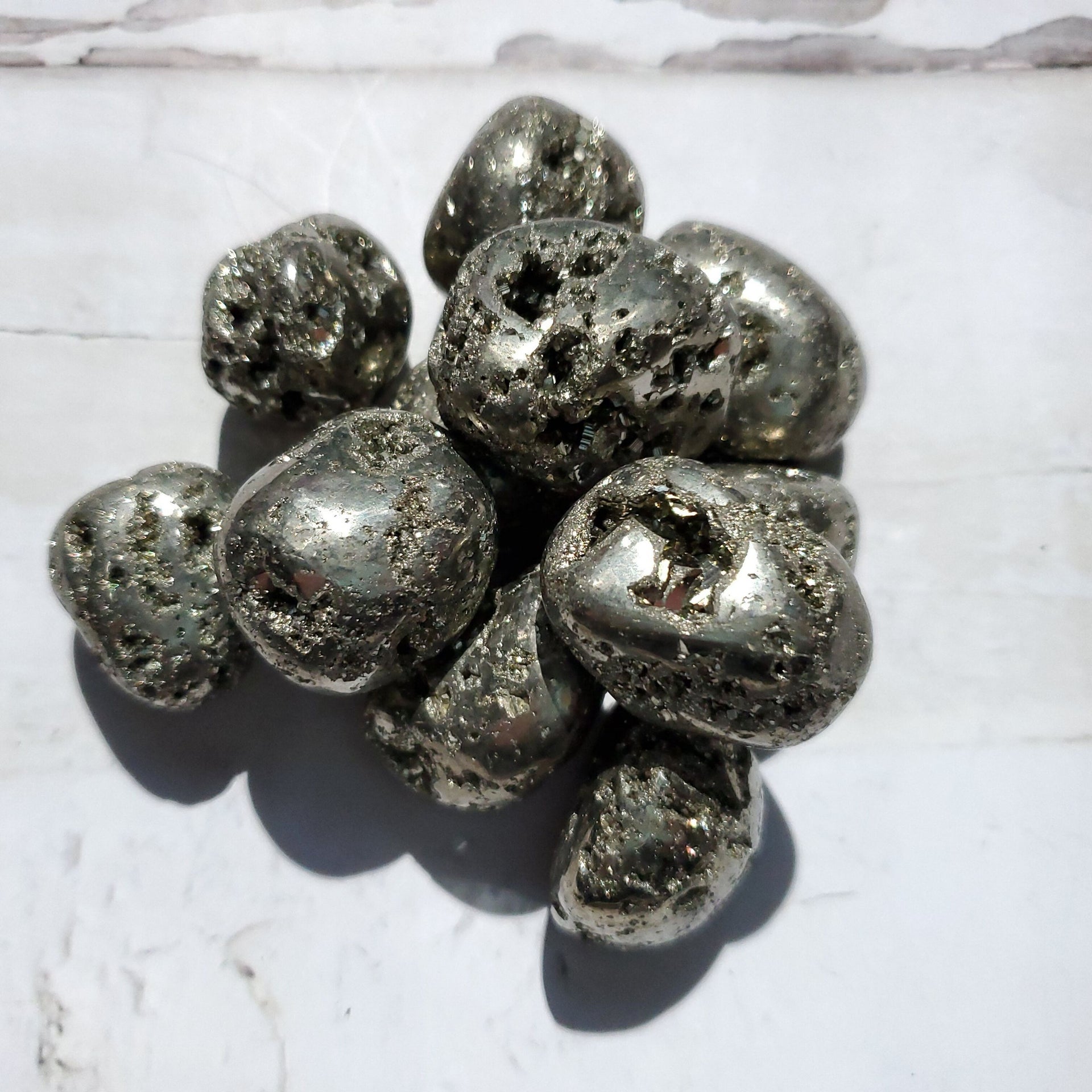
This striking Pyrite Tumble is one of the most instantly recognizable and historically fascinating minerals on Earth — its brilliant, brassy gold color and metallic luster have dazzled and deceived for millennia, earning it the legendary nickname "Fool's Gold," while its powerful energy of abundance, confidence, and solar vitality makes it one of the most beloved prosperity stones in the crystal world.
Note: Pyrite is also known as Iron Pyrite or Fool's Gold — the latter name earned during gold rushes when inexperienced prospectors mistook its glittering appearance for real gold. Despite the nickname, Pyrite is a genuinely remarkable mineral with a fascinating history and real scientific significance. Pyrite can oxidize over time when exposed to moisture and air, producing iron sulfate and sulfuric acid — a process called "pyrite disease" or "pyrite decay." Keep your Pyrite dry and avoid prolonged exposure to humidity.
Where It Is Found
Pyrite is one of the most abundant sulfide minerals on Earth, found worldwide in a wide variety of geological environments. Major sources of the fine crystalline Pyrite used in the crystal market include Spain (the Rio Tinto mining district in Andalusia, one of the world's most famous Pyrite deposits, mined since at least 3000 BCE), Peru (the Huanzala and Quiruvilca mines, famous for spectacular cubic Pyrite crystals), Italy (the island of Elba), Russia, China, and the United States. Peru is particularly renowned for producing the perfect, mirror-bright cubic Pyrite crystals that are among the most prized mineral specimens in the world.
Mineral Class / Geology
Pyrite is an iron sulfide mineral (FeS₂) belonging to the Sulfide mineral class, with a hardness of 6–6.5 on the Mohs scale. Its name comes from the Greek pyr, meaning "fire" — a reference to the sparks it produces when struck against metal or stone, a property that made it one of the earliest fire-starting materials used by humans. Pyrite forms in a remarkably wide variety of geological environments including hydrothermal veins, sedimentary rocks, metamorphic rocks, and as a replacement mineral in fossils (creating the spectacular "pyritized" fossils prized by collectors). It is the most common sulfide mineral on Earth. Pyrite's characteristic crystal habit is the perfect cube — one of the most geometrically precise natural crystal forms, with flat faces and sharp right-angle edges that seem almost artificially manufactured. It also forms in pyritohedra (12-faced crystals) and octahedra. Pyrite is also an important source of sulfur for sulfuric acid production and has been used as an ore of gold — many gold deposits occur in association with Pyrite, and "invisible gold" is often found within Pyrite crystal structures.
Colors
Pyrite displays a brilliant, brassy to pale gold color with a bright metallic luster — one of the most convincing natural imitations of gold in the mineral world. It is opaque with a distinctive greenish-black streak (which distinguishes it from real gold, which has a yellow streak). Tumbled Pyrite has a smooth, warm golden surface that catches light beautifully.
Metaphysical Properties
Pyrite is known as the Stone of Abundance, Confidence, and Solar Power. Despite its "Fool's Gold" nickname, there is nothing foolish about Pyrite's powerful energy — it is one of the most potent prosperity and manifestation stones in the crystal kingdom. It resonates with the Solar Plexus Chakra and is used to attract abundance, wealth, and prosperity, boost confidence, willpower, and personal power, enhance mental clarity, focus, and the ability to take decisive action, provide a strong protective shield against negative energies, stimulate creativity and the drive to manifest ideas into reality, overcome procrastination and self-doubt, and connect with the bold, solar energy of fire and gold.