
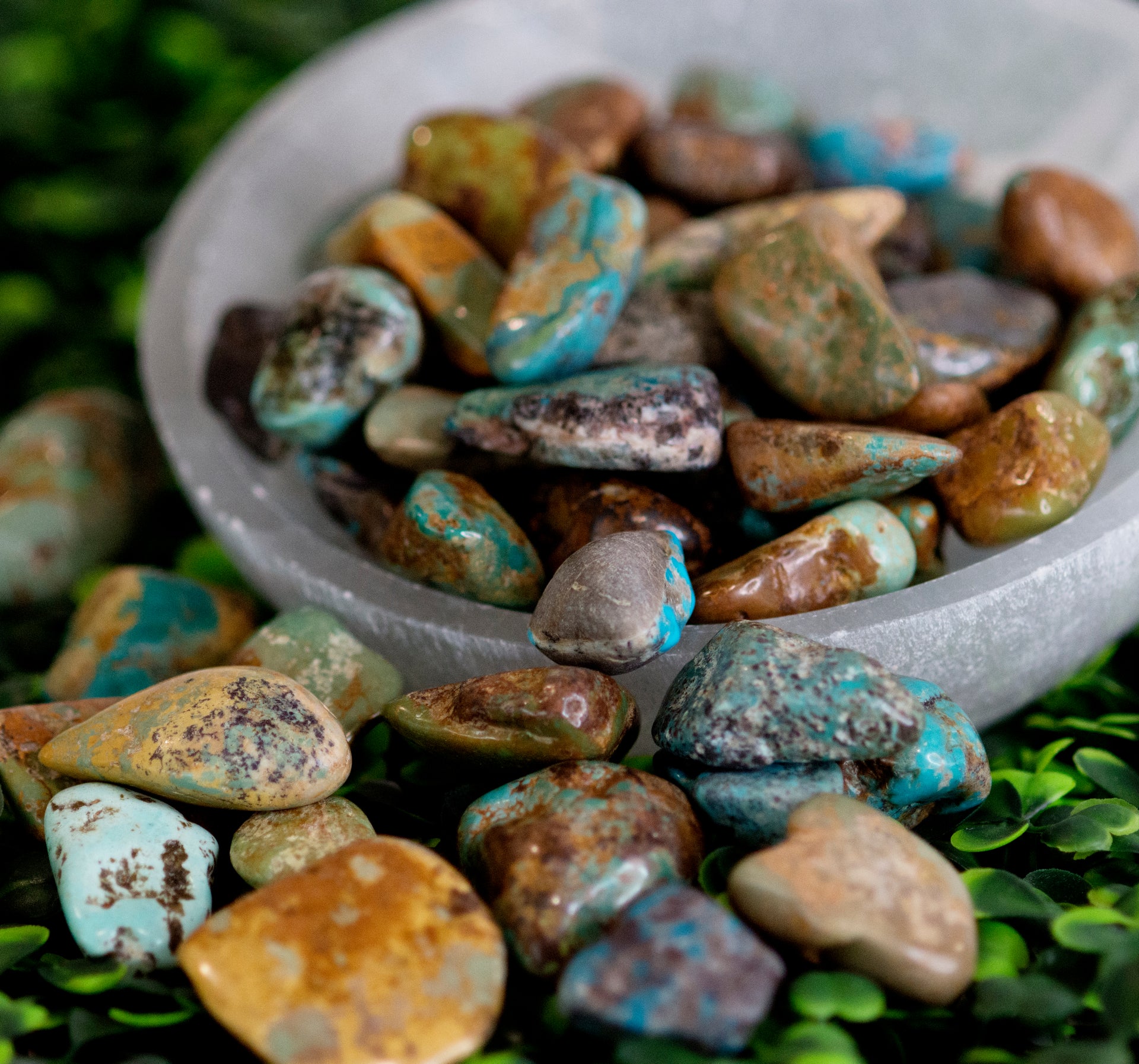
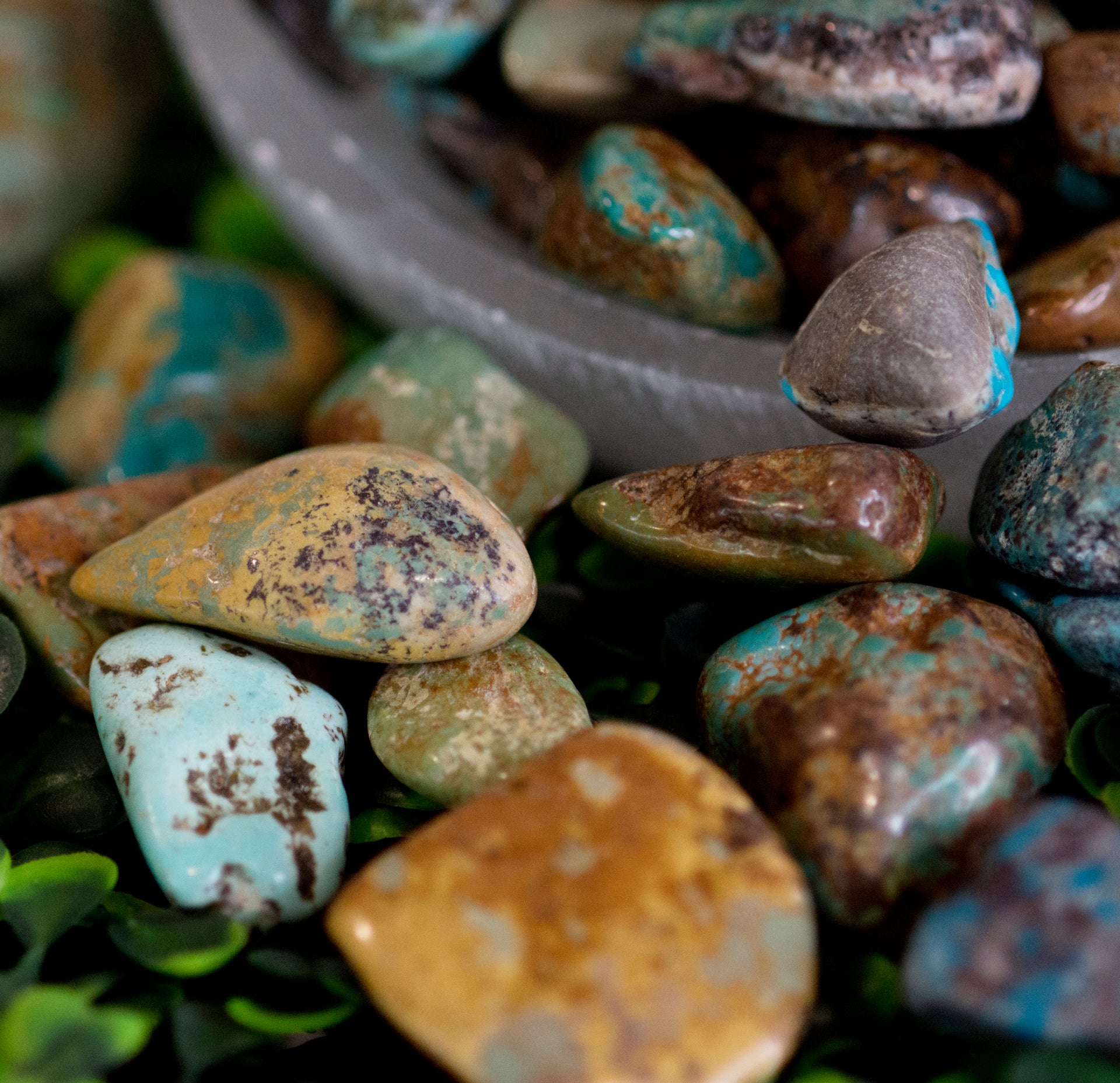
TURQUOISE TUMBLE
TURQUOISE TUMBLE
Turquoise
This beautiful Turquoise Tumble carries the energy of one of the oldest and most universally revered gemstones in human history — prized for over 7,000 years across ancient Egypt, Persia, Tibet, the Americas, and the Native American Southwest, Turquoise's distinctive blue-green color and powerful protective energy have made it a sacred stone across virtually every civilization that has encountered it.
Important note on authenticity: Turquoise is one of the most frequently imitated gemstones in the world. "Turquoise" on the market ranges from genuine natural Turquoise to stabilized Turquoise (natural Turquoise hardened with resin), treated Turquoise (dyed or color-enhanced), and imitation Turquoise (dyed Howlite, dyed Magnesite, or plastic). We are transparent about the nature of our Turquoise. Natural, untreated Turquoise is increasingly rare and commands premium prices; most affordable Turquoise in the crystal market is stabilized or treated.
Where It Is Found
Turquoise is found in arid, copper-rich regions worldwide. Major sources include Iran (Persia) — historically the source of the finest "Persian Turquoise" for thousands of years, particularly the Nishapur mines in Khorasan; the American Southwest (Arizona, Nevada, New Mexico, Colorado — including famous mines such as Sleeping Beauty, Kingman, Bisbee, and Royston); China (now the world's largest producer); Egypt (Sinai Peninsula, mined since at least 3200 BCE); Tibet; and Mexico.
Mineral Class / Geology
Turquoise is a hydrated copper aluminum phosphate mineral (CuAl₆(PO₄)₄(OH)₈·4H₂O) belonging to the Phosphate mineral class. Its hardness varies from 5–6 on the Mohs scale — natural Turquoise can be quite soft and porous; stabilized Turquoise is harder. Turquoise forms as a secondary mineral in the oxidized zones of copper ore deposits in arid environments, where copper-bearing groundwater reacts with aluminum-rich phosphate minerals. Its distinctive blue-green color is caused by copper (blue tones) and iron (green tones) — the ratio of copper to iron determines whether a piece leans more blue or more green. The dark veining or matrix visible in many Turquoise specimens is the host rock (typically limonite, sandstone, or other minerals) in which the Turquoise formed. Higher quality Turquoise has a more intense, even color and less matrix; the most prized is a pure, robin's-egg blue with no matrix.
Colors
Turquoise displays a distinctive spectrum of blue-green — from pale sky blue and robin's-egg blue to deeper teal and blue-green, often with dark brown, black, or golden matrix veining. The color is caused by copper (blue) and iron (green) in varying ratios. Each piece is unique in its color and matrix pattern.
Metaphysical Properties
Turquoise is known as the Stone of Protection, Wholeness, and Ancient Wisdom. It is one of the most universally protective stones in the crystal kingdom, revered across cultures as a powerful talisman against harm, negativity, and misfortune. It resonates with the Throat and Third Eye Chakras and is used to provide powerful protection against negative energies, accidents, and harm, enhance communication and authentic self-expression, connect with ancient wisdom and spiritual guides, bring a sense of wholeness, balance, and inner calm, support physical healing and the immune system, enhance intuition and spiritual awareness, and serve as a bridge between the earthly and spiritual realms.